
|
|
 |
LANGUAGE |  |
 Home Page |
About Page |
Custom Page |
Custom2 Page |
Custom3 Page |
Favorite Links Page Home Page |
About Page |
Custom Page |
Custom2 Page |
Custom3 Page |
Favorite Links Page |
|
THE LIMITLESS NUMBER OF THAI WORDS WHICH MEAN ' I ' |
||||
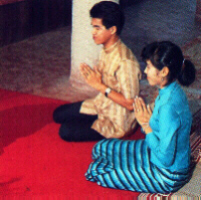 ( Chan) (Dichan) (Momchan) ( Klao kramomchan) (Pom) (Krapom) (Klao krapom) (Mom) (Kramom) (Klao kramom) There are several sets of hierarchical "I" in the Thai language,begining with ordinary words and embellished to become social forms. The commonly used "CHAN" (male) and "DICHAN' ( female) used in everyday speech by people of equal ranks,become 'MOMCHAN' in the royal language,and 'KLAO KRAMOMCHAN used while speaking to the royalty of even higher status. Another common word is 'POM' (male)'KRAPOM' (male) and 'KLAO KRAPOM'(male) in hierarchical order This last example is used by commoners speaking to commoners. The royalty,speaking to other members of the royalty,will change to the set of 'MOM'(male), 'KRAPOM'(male) and ' KLAO KRAMOM' (male) |
(Ku) ( Kha ) ( Kha pa chao) ( Kha pra putta chao) The earlist recorded word for "I" in Thai is "Ku" which appears in the inscription of King Ramkhamhaeng of Sukhothai,said to be the oldest evidence of Thai writing. This word derived from the "T'ai dialects and is still in use today in formal and impolite usage. As the language developed.word from began t reflect the social hierachy of the period. For example, "Kha" (lit. "servant") was used by persons of equal social status,or by a person to stress his superior status over the one being spoken to. On a higher social plane, "Kha pa chao" ( Lit. the lord's sevant") is used in formality and (Kha pra putta chao) (lit. The Buddha's servant) is used while speaking to the high royalty or to the King. |
|||
|
( Rao) (Ua) ( I ) (Khru) (Archan) (Attama) ( Atma) |
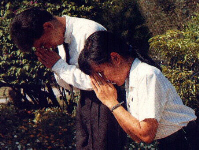 (Pi) (Nong) (Nu) (Luk Chang) (Bow) (Kha luang) (Chai) (Ying) (Koi) (Riam) (Tu) (Tua ku) Clos relatives use words which denote personal relationships and status. For example, 'Pi' older sibling and 'Nong' younger sibling. A subordinate will use term of endearment to a superior such a 'Nu (lit. Mouse), 'Luk Chang' (Lit baby elephant) 'Bow' (lit.servant) and 'Kha Luang' (lit your servant). In this group may be included "Chai' (lit.man) and "Ying' (lit.Woman) which is the way some people call themselves. The are also ethnic words: "Koi'. "Riam "Tu' and "Tua Ku' |
|||
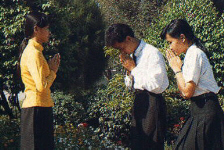 (Ja) (Phu khong) (Phu phan) A large group of pronouns derive from military ranks Not only do the rank and file call officers and enlisted men by their ranks.the officers call themselves by rank also. For example, A sergeant may call himself " Ja' (non commisioned officer) while speaking to his men. |
||||